The Case For Writing

Artful Sentences: Syntax as Style by Virginia Tufte

WRITING

Sitting in the garden with my coffee-stained copy of Virginia Tufte’s Artful Sentences: Syntax as Style, I’m lost in the possibilities of using prepositions, free modifiers, and parallelism. I can’t help myself; this nerdy undertaking feeds the fire of possibilities. So many options, so many words!  All of these elements come together in a moment of clarity to articulate ideas from my thoughts to my fingers. 

To a page.

I started this essay in June. It’s now August. I worked on other things, but circled back to this, struggling with how to communicate ideas about writing, and what is lost with using large language models, LLMs, in place of the human arrangement of words.

Look, I get it: We can’t escape AI. It’s here. LLMs are problematic, riddled with errors, annoying, but AI could be developed to do things better (or, take over humanity… but that’s a different story). I want to believe that one day AI could cure diseases, stop wars, and reverse climate change. But right now, LLMs are making us stupid, and I really hate reading LLM-generated sentences.

CRITICS

The greatest thing since sliced bread sure doesn’t skimp on energy consumption. In 2023, AI data centers consumed 4.4% of U.S. electricity. According to Mahmut Kandemir, a computer science and engineering professor at Penn State, “[b]y 2030–2035, data centers could account for 20% of global electricity use, putting an immense strain on power grids.” Research done by Virginia Tech found that data centers use approximately 0.5% of total greenhouse gas emissions in the U.S. Researchers want more transparency from AI companies, but they are not disclosing much.

Artists and writers have long been critics because AI companies steal their work without compensation and train their AI to create in the style of most anyone a user fancies. In July of this year, author David Baldacci testified before the Senate Crime Subcommittee and had this to say about LLMs: “I truly felt like someone had backed up a truck to my imagination and stolen everything I’d ever created.”  Baldacci is one of more than 15,000 writers who signed an open letter from the Authors Guild to obtain consent and compensate writers for using their works to train LLMs.

In a recent New York Times article, author and professor Meghan O’Rourke makes this unpleasant but apt connection: “I came to feel that large language models like ChatGPT are intellectual Soylent Green . . . After all, what are GPTs if not built from the bodies of the very thing they replace, trained by mining copyrighted language and scraping the internet?”

Most alarming are the vulnerable users who suffer when AI prompts convince them of self-harm or delusions–AI psychosis. Recent articles detail how certain chatbot users were made to believe they were robots, had superpowers, or were spiritual beings, and the like. AI mimics a sentient voice that flatters and pretends to understand, which is, quite frankly, the stuff of nightmares.  

Finally, there’s the very obvious problem that AI gets a lot wrong. Research published earlier this year in the Columbia Journalism Review found that AI search engines gave the wrong answer 60% of the time. 

TEACHING

I have two jobs: I’m an adjunct English teacher for a community college in Texas. I teach eight-week-long required literature courses online. I am also a teacher for an alternative learning program at a public high school in Washington State. 

Like many professors, I read a substantial amount of LLM-generated essays in my college classes. Though I have strongly worded guidelines against AI and plagiarism, students eager to get through their required classes find it convenient to have LLMs churn out essays. Why not? It’s easy and saves them hours of work. Most of my students are not humanities majors, and reading literature critically is a gloriously unpleasant waste of their time. Don’t get me wrong, I also have focused, hard-working students who truly love to learn. These are the ones who often email me at the end of class to let me know what a particular author, story, or poem meant to them. It gives me hope that they are going out into the world with a little more perspective, understanding, and empathy. But the other students? They may ride through my class without reading any of the assigned work.

And there is nothing I can do about it. 

I know professors are coming up with ways to avoid the deluge of AI. Some are creating community outreach assignments or having students write in-class essays; I can’t do this in an online course. I’ve changed my rubrics to focus more on originality, but I know I’m still assigning grades to work that students didn’t write. 

In my high school job, I’m also reading AI-generated work. It’s easy with online courses created by outside vendors with predictable writing prompts. If parents are not monitoring their teens at home, the temptation can be too great. Why write an essay when you could be watching TikTok or playing League of Legends? 

I spend many hours trying to figure my way through this mess. 

And there is nothing I can do.

EMBRACING AI 

There’s a movement in Washington State for using AI in the classroom. Many universities and colleges embrace AI learning as well. We’re told we should move toward the future by guiding students on how to use AI responsibly. Obviously, pretending like AI doesn’t exist isn’t the answer, but when it comes to LLMs, I’m not feeling the enthusiasm.

Let’s consider this passage from the Human-Centered AI Guidance for K-12 Public Schools from the Washington State Office of Superintendent of Public Instruction.

“ . . . educators are encouraged to weave AI into the fabric of learning in a way that respects and uplifts the human dimension of education. This approach not only navigates the complexities of integrating AI into teaching and learning but also underscores the educators’ indispensable role in moderating the influence of AI, ensuring that it augments rather than replaces the nuanced processes of human teaching and learning.”

This AI-generated drivel demonstrates the classic problem with AI writing. The words sound fancy, but the passage doesn’t impart anything of value. Phrases like “weave… into the fabric of learning,””uplifts the human dimension,” and “navigates the complexities” might flatter teachers into thinking we have some sort of control in the teaching of AI.  How do we “augment” rather than replace the “nuanced process” of learning? How is this supported by research? The lack of specificity leaves me frustrated and annoyed. 

What are we supposed to do, exactly?

The pattern in schools is a familiar one. A new technology emerges, and companies vie for contracts with schools so that children are not left behind in the next big thing. From word processing to Photoshopping skills, embracing the new has always been the norm. Now, of course, the push is for students to be equipped with AI. 

Evan Gorelick’s article in the New York Times covers the recent deal with Microsoft and OpenAI with school districts across the United States. According to Gorelick: “Tech companies are using an old marketing strategy: Promise that the latest tech will solve classroom problems.” He noted that there is little evidence that the push to get all students on laptops in the early 2000s made a significant difference in learning. Gorelick explains,“[t]wo decades later, tech companies are still peddling the same fear of missing out: They suggest students need cutting-edge tools for tomorrow’s economy, and schools that don’t provide them are setting their students up for failure.”

In our current Washington state AI push,  a primary colored 1990s-style handout details the fabulous future of human-driven AI in the classroom with an AI Assignment Scaffolding Matrix for different classes. 

Consider the following example showing a flash fiction writing assignment based on a short story by Octavia Butler:

AssignmentLevel 1No AI AssistanceLevel 2AI Assisted BrainstormingLevel 3AI Assisted DraftingLevel 4AI Collaborative CreationLevel 5AI as Co Creator
Butler-inspired Flash Fiction – Drop us right into a scene with a character, in a highly specific location. Emulate Butler’s writing style however you can. Examples include: a first-person point of view, spare prose, genre-bending plotWrite a reflective journal entry or creative piece using personal insights only.Generate prompts with AI, but the reflective or creative writing is student’s ownDraft creative writing with AI support, but student personalizes the final piece.Create a story with AI, student adds unique perspective and revises for final version.AI aids in crafting a narrative, student refines and adds creative elements

This rubric is vague, illogical, and probably AI-generated.  If followed, this will not foster student learning (with the exception of level one).  Significantly, there is no obvious difference between levels three, four, and five. What is the difference between “draft creative writing with AI support,” “ Create a story with AI,” and “AI aids in crafting a narrative”? Isn’t this stating that AI is doing the writing for the student? Yes, the student may “personalize” and add a “unique perspective” or “refines and adds creative elements,” which lacks specificity. These examples seem to imply that AI is doing the writing, and the student could make some changes. In addition, some students may be tempted to use AI programs like Quillbot to do the revisions, like finding synonyms, paraphrasing, or making the tone more like a high school student. But even if a student does their own revising, the student did not write the story. Level five is not an example of a “Co-Creator.” There is nothing collaborative about adding creative elements to something already written by AI. 

In each of these examples, the LLM creates. The student, at most, accessorizes the story. A science fiction story, flash fiction! It’s a sad day when we think we need AI to create this for us.


RESEARCH

A recent MIT study examined students’ brains in AI. The students were divided into three groups: those who used only LLMs, those who used only their own brains and actual texts, and those who could use search engines without AI.

The researchers used electroencephalography (EEG) to measure and assess the cognitive load of the participants. The result showed that “EEG revealed significant differences in brain connectivity: Brain-only participants exhibited the strongest, most distributed networks; Search Engine users showed moderate engagement; and LLM users displayed the weakest connectivity.” 

The researchers found: “Over four months, LLM users consistently underperformed at neural, linguistic, and behavioral levels.” This research is telling, but it provides scientific data that reflects the obvious: If students are not engaging in reading, thinking, and writing, then they are not learning. The researchers conclude: “This suggests that while AI tools can enhance productivity, they may also promote a form of ‘metacognitive laziness,’ where students offload cognitive and metacognitive responsibilities to the AI, potentially hindering their ability to self-regulate and engage deeply with the learning material.”

Some would argue that we should allow students to use AI for some tasks. Writing is daunting, it’s hard, messy, and confusing at times. Writing doesn’t always work in a linear fashion (though we often teach it that way). Students struggle. Some students have learning challenges, and some students are English language learners. Phones and other electronic entertainment provide an easy escape from hard learning. 

BACK TO WRITING

We’re encouraged to teach students shortcuts, and in this process, destroy the capacity for learning. A soccer player doesn’t have someone do the hard work of practicing and then step in for the game. A musician doesn’t have someone else practice daily and then refine for a performance. In the same way, the writer must write. LLMs should not stand in for the work. 

University of Washington professors Carl T. Bergstrom and Javin D. West created a teaching guide, “Modern-Day Oracles or Bullshit Machines? How to Thrive in a ChatGPT World,” which covers how we should approach LLMs and teaching with a skeptical eye. They argue that “writing is a generative activity. We write to figure out what we think. When we write, we sharpen our ideas, refine our thinking, and engage in a creative activity that yields new insights only once pen hits paper. If we offload the task of writing onto an AI, we lose the opportunity to think.”

Author and professor, Cal Newport, considers this: “. . . to grapple fully with this new technology, we need to better grapple with both the utility and dignity of human thought.”  The dignity of learning, the struggle, and reward are valuable and cannot be overlooked.

Meghan O’Rourke argues that “[t]he uncanny thing about these models isn’t just their speed but the way they imitate human interiority without embodying any of its values. That may be, from the humanist’s perspective, the most pernicious thing about A.I.: the way it simulates mastery and brings satisfaction to its user, who feels, at least fleetingly, as if she did the thing that the technology performed.” 

But the satisfaction can only be fleeting. There is no ownership or sense of accomplishment if AI does it for you. 

The artifact is the writing. Imperfect, but a creation. One crafted from hard work. With AI, this is gone. The creation is gone. The connection between the text to the brain is gone. The reading, thinking, drafting, revising, editing, and submitting process is gone. 

What’s left for us to know we struggled and created?

Summer Writing

We’re getting our short season of warm weather on Orcas Island. I’m working on revisions and trying to get my garden in order. Both require patience, pruning, and deep watering. (I know, I know–bad writing metaphors). What is deep watering for writing? Deep thinking? Letting my thoughts run deep into the roots of the story . . .

Here’s my summer office. I enjoy working with a breeze and birdsong.

A photo of my outdoor office

Gaping Holes

Murder, She Writes

Anyone who has wrestled with writing a story has most likely faced that echoing, horrible pit of “Nothing is Working.” I recently found a gaping plot hole in my work in progress and am not sure I fixed it in the best way possible. I wish to fix it in such a way that no one will ever know a hole existed, but sometimes the problem doesn’t have an easy solution. I will be weeding the garden, driving my car, or washing the dishes, and I bet, the answer to the problem will appear.

At least that’s been my experience.

I recently finished reading a mystery novel from a series that wasn’t one of my favorite reads. I’m not going to share the author or title here because you, dear reader, may find the book compelling. The writer’s work is popular, so I cheer her on.

The challenge with the book? The crime didn’t logically make sense. The murderer didn’t need to murder the victim to get what they wanted, and, at least in the story, no motivation was given. As both a writer and a reader I’ve experienced my share of the suspension of disbelief. I am willing to accept or create something that pushes expectations. There’s a kind of magic here worth indulging in.

In this unnamed novel, the murder was planned. It was not a passionate outburst that the antagonist later regretted. The process of figuring out the murder held my interest, but the writer also used a number of unnecessary workplace dramas that seemed unrealistic and petty. The kind of things that would send most of us in search of a better job.

Again, this is my subjective response. I hope the writer has avid readers and sells many books.

With my own work? Well, I’ll keep at it. I do love my characters and hope my readers will as well. That plot hole will be fixed and the story will move forward. Often, when I struggle, a stronger answer emerges.

Write on!

Aurora Borealis, May 10, 2024

Howdunit

Murder, She Writes

I’m taking a break from reviewing mysteries to cover this delightful collection of essays created by crime writers: Howdunit: A Masterclass in Crime Writing by Members of the Detection Club, edited by Martin Edwards. This gem is a collection of 90 writers, including greats like Agatha Cristie and Dorothy L. Sayers to contemporary writers across all genres from traditional mysteries to thrillers.

The book is divided into sections like “Motive,” “Beginnings,” “Plots,” “Detectives,” and “Writing Lives.” It’s not a book that must be read from start to finish, though nothing would stop the reader from taking this approach. I particularly loved an image of a handwritten flow chart by Kate Ellis. A great reminder that some of our best ideas start with scribbles on a sheet of paper.

There are no rules. The only moral compass is honesty, writing to the best of your ability.

A straight avenue to the heart. –Frances Fyfield

It’s a book full of new writers to explore and familiar ones to reconnect with. It’s also a book that, as a writer, I found the shared experience of the challenges of creation and the beauty of putting the puzzle pieces together.

This book’s strength covers both the predictable and the quirky unexpected; those thoughts writers have when caught at a desk for hours wound up in ideas about crimes, clues, and detectives.

A book I keep by my desk for inspiration!

Going to the Dogs

Murder, She Writes

Art by Laura Catalán

In need of something that had nothing to do with the state of the world, I found Wendelin Van Draanen’s recent middle grade mystery, Mr. Whiskers and the Shennanigin Sisters, and entered a world of an old, mysterious house (with secret passages!), two tenacious sisters, a father gone missing, pirate treasures and more–all told through the unique perspective of a dog. That’s right. This book is from a dog’s point of view.

Not just any dog, but a clever, street-smart, and all-around good boy.

Van Draanen is a popular writer who has published many children’s books, including the popular Sammy Keyes series. Her mastery of the middle grade is evident in this story. When Misty and Zelda’s dad gets ordered away by some suspiciously bogus FBI agents, it’s up to Mr. Whiskers and the sisters to save the day. In an old San Francisco boarding house where the sisters live, they find clues and old pirate secrets that lead them to their dad.

The voice of Mr. Whiskers was especially fun because Van Draanen creates an authentic sense of a dog’s point of view with some creative woofy puns. Obviously, this dog is not the only animal perspective in middle grade, but I found it interesting here because Mr. Whiskers must interact with humans, who do not always understand his clever insights.

The book begins with a whiff of danger:

I smelled trouble. It came driftin’ in off a fella on the sidewalk outside and tickled up my schnoz clear down to my paws

I hope this one becomes a series!

The Red Palace

Murder, She Writes

I was fortunate enough to recently receive some feedback on my writing from Kat Brzozowski (Senior Editor at Feiwell & Friends), she mentioned I should read The Red Palace, by June Hur. I’m so glad I did!

Hur’s YA historical mystery takes place in Korea in the year 1758. Hur’s lyrical prose pulls the reader right into the story without needing to explain everything. Though this era in history was previously unfamiliar to me, I was able to slide into this world through Hur’s effortless style. Of course, I doubt it was effortless (writing is hard!), but it felt effortless.

The protagonist, Hyeon works as a palace nurse, and when her mentor is accused of killing multiple women, Hyeon is called into action; despite warnings that she should stay out of trouble, she investigates to find the real killer. There are layers of challenges–a strict socioeconomic system, specific gender roles, and family complications. The clues lead the characters to believe that the Crown Prince could be responsible for the murders, which further complicates the story.

Along the way, Hyeon joins forces with Eojin, a police inspector and a romance flourishes. Hyeon and Eojin must work together to find the truth and put themselves in great danger.

The story has satisfying plot twists, unique settings, a fascinating social history, and a budding romance.

A unique and wonderful read with universal themes!

Crime to Spy

Murder, She Writes

It’s been a busy few weeks with a plethora of essays to grade followed by a delightful trip to southern Colorado where I enjoyed time with my family.

Quaking aspens!

Today’s post is a look at Ashley Weaver’s historical Electra McDonnell series. The story takes place during WWII in London where Ellie McDonnell works with Uncle Mick, a locksmith, who, when necessary, also picks locks and breaks into the safes of the wealthy. One night while orchestrating an illegal job, they are caught and offered a deal: They can avoid arrest if they help the British government with some clandestine work. They agree though Ellie is not particularly taken with Major Ramsey, the uptight but (of course) attractive man in charge.

The plot is engaging with clever spy work, cryptic clues, and betrayal; Weaver employs twists and layers that keep the reader guessing.

Along with the adventures in espionage, Ellie and Major Ramsey move from frustration to admiration and back again, in a growing circle of attachment. Their romantic feelings are obvious though Ellie pretends they couldn’t possibly exist. A twist is that Ellie is also dealing with romantic feelings for her longtime family friend, Felix.

Which man will eventually win Ellie’s spirited heart?

Ellie is strong-willed and smart, and she eventually takes pride in helping the government; Ramsey reflects his name a bit. He craves order and is quick to anger when his plans are thwarted.

The characters experience doubt, fear, frustration, humor, compassion, and connection in their desire to stop the German spies.

I’ve been listening to this series on my commute, and it’s a great dive into the dangerous and intriguing past. My only frustration is that I have to wait until next year to read the 4th book in the series.

To Catch a Heart

Murder, She Writes

Back from a trip to California . . .

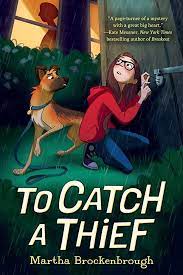
I recently read Martha Brockenbrough’s sweet middle grade mystery novel, To Catch a Thief.

The story unfolds when an unknown thief steals a dragonfly staff, an important and reportedly lucky artifact for the quaint town of Urchin Beach. Amelia MacGuffin decides she will use her detective skills to find out who is behind the missing staff (and a number of other items that disappear).

To complicate matters, a major storm hits the community, odd new neighbors show up, and the MacGuffin children rescue a sweet dog that they probably will not be able to keep because their family cannot afford a pet.

I love the seaside town setting, and this book has heaps of fun characters: Dr. Agatha, the reclusive mystery writer; Dot and Dash, the new 7th-grade Morse-code-expert twins; Birdie, a student journalist, and even a grumpy real estate agent named Mike Jung (who interestingly shares the same name as a writer I met once . . .).

In fact, all sorts of writers are mentioned like Kekla Magoon, William Alexander, Linda Urban, Olugbemisola Rhuday-Perkovich, Kelly Barnhill, Anne Ursu, Laurel Snyder, Laura Ruby, Tracey Baptiste . . .

Writers who write books Amelia, her siblings, and even her dad love to read.

Amelia hoped she would grow up to be the kind of grown-up who remembered that kids know what’s good and not boring.

Martha Brockenbrough

At the core of this sweet mystery is the MacGuffin family: Amelia, and her younger siblings–Bridget, Colin, and the twins, Duncan and Emma.

I’m a big fan of Martha’s books. Her works include masterful syntax, funny dialogue, and strong plots, but most of all, she understands the emotional core of her characters. In this case, Ameilia realizes what is truly important in her world and this emotional core to the story feels completely authentic.

Like Mr. MacGuffin, I still read plenty of books for younger readers. What would 10-year-old Michèle have thought of this book? Would I have liked it? Oh, yes!

I really hope the adventures of Amelia and her crew will become a series!

Canadian Adventures

Murder, She Writes

Design and Illustration by Margaret Hanson

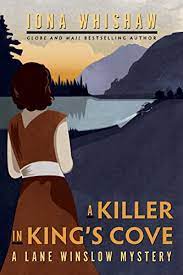
I recently stumbled across a delightful series from British Columbia, the Lane Winslow mysteries by Iona Wishaw. This series has many tempting boxes to check: The setting, the historical era, the characters, and of course, twisty plots!

A Killer in King’s Cove begins in 1946 near Nelson, BC, we meet Lane Winslow, who left England and recently purchased a charming old house in King’s Cover where she plans to write and garden, but when a body turns up, her new peaceful life gets a tad more challenging. Lane worked as a British Intelligence officer in WWII and is mending from a broken heart and the horrors of war. Nevertheless, she is clearly a modern woman. She will not swoon at the sight of a corpse, and she’s persistent with coaxing seemly subtle clues that eventually reveal answers.

Other characters include eclectic neighbors and the attractive but aloof police detective, Inspector Darling, who tries to resist the allure of the beautiful and brilliant new resident. This slow-burn relationship builds with the series, as the two characters realize they cannot deny their connection.

I like Winshaw’s commitment to historical details; she’s clearly done her research. I also like the strong point-of-view shifts that build scene by scene as readers are introduced to other characters and other puzzle pieces of the plot. Like a focus on a lens, the story suddenly comes into view.

I’m eager to read more books in this series!

Gaudy Feelings

Murder, She Writes

I’m heading back in time to one of my favorite writers from the heyday of British detective fiction, Dorothy L. Sayers. The protagonist in Sayers’ novels is Lord Peter Wimsey, an intelligent, wealthy British nobleman veteran who suffers from bouts of PTSD when he isn’t solving mysteries.

Harriet Vane, a mystery writer, and Wimsey’s love interest, first shows up in Strong Poison, where she is accused of her lover’s murder until Wimsey figures out what really happened. Wimsey wants to marry her, but she hesitates to marry him for a number of reasons, both rational and irrational.

Gaudy Nights takes place at Oxford University in the fictional women’s college, Shrewsbury. Harriet Vane reluctantly returns to an annual reunion, called a Gaudy at the request of an ill former classmate. Soon she is engrossed in a mystery at the college, where a poisoned pen writer is sending out hateful messages to students and faculty. This mystery Harriet works on methodically and with an intellect not often seen in female characters of the era.

In all her novels, Sayers considers the psychology of our experiences–love, shame, anger, guilt, and more. Gaudy Nights, in particular, provides plenty of opportunities for Harriet Vane’s perspective on the roles of women, marriage, her own role in marriage (if she were to marry Wimsey), and the challenges of being attracted to someone while concerned about the long-term outcomes of where attraction can lead. Will she lose her sense of self?

I enjoy the banter and intellectual interactions between Vane and Wimsey. As the story evolves, the mystery of the person behind the poisoned pen notes and all-around mischief-maker grows increasingly dangerous. Sayers was a master at complex plots with heaps of clues in multiple directions; that is one of the many reasons I find her novels worthwhile.

Though Sayer asserts a critical view of the treatment of women, especially intellectual women, there are some classic male and female tropes. Considering the publication date of 1935, the underlying stereotypes represent a reflection of the era. With that said, Wimsey is one of the early detective characters who evolves over time as a complex human, not merely a bright and witty rich guy. Vane’s leading role in this novel demonstrates Sayer’s understanding that a woman’s perspective is as valuable as a man’s.

“What are you to do with the people who are cursed with both hearts and brains?”

Doorothy L. Sayers

There is a solution, but I will not give it away!