Canadian Adventures

Murder, She Writes

Design and Illustration by Margaret Hanson

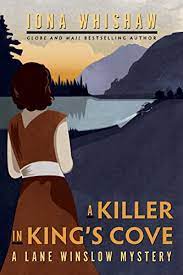
I recently stumbled across a delightful series from British Columbia, the Lane Winslow mysteries by Iona Wishaw. This series has many tempting boxes to check: The setting, the historical era, the characters, and of course, twisty plots!

A Killer in King’s Cove begins in 1946 near Nelson, BC, we meet Lane Winslow, who left England and recently purchased a charming old house in King’s Cover where she plans to write and garden, but when a body turns up, her new peaceful life gets a tad more challenging. Lane worked as a British Intelligence officer in WWII and is mending from a broken heart and the horrors of war. Nevertheless, she is clearly a modern woman. She will not swoon at the sight of a corpse, and she’s persistent with coaxing seemly subtle clues that eventually reveal answers.

Other characters include eclectic neighbors and the attractive but aloof police detective, Inspector Darling, who tries to resist the allure of the beautiful and brilliant new resident. This slow-burn relationship builds with the series, as the two characters realize they cannot deny their connection.

I like Winshaw’s commitment to historical details; she’s clearly done her research. I also like the strong point-of-view shifts that build scene by scene as readers are introduced to other characters and other puzzle pieces of the plot. Like a focus on a lens, the story suddenly comes into view.

I’m eager to read more books in this series!

Gaudy Feelings

Murder, She Writes

I’m heading back in time to one of my favorite writers from the heyday of British detective fiction, Dorothy L. Sayers. The protagonist in Sayers’ novels is Lord Peter Wimsey, an intelligent, wealthy British nobleman veteran who suffers from bouts of PTSD when he isn’t solving mysteries.

Harriet Vane, a mystery writer, and Wimsey’s love interest, first shows up in Strong Poison, where she is accused of her lover’s murder until Wimsey figures out what really happened. Wimsey wants to marry her, but she hesitates to marry him for a number of reasons, both rational and irrational.

Gaudy Nights takes place at Oxford University in the fictional women’s college, Shrewsbury. Harriet Vane reluctantly returns to an annual reunion, called a Gaudy at the request of an ill former classmate. Soon she is engrossed in a mystery at the college, where a poisoned pen writer is sending out hateful messages to students and faculty. This mystery Harriet works on methodically and with an intellect not often seen in female characters of the era.

In all her novels, Sayers considers the psychology of our experiences–love, shame, anger, guilt, and more. Gaudy Nights, in particular, provides plenty of opportunities for Harriet Vane’s perspective on the roles of women, marriage, her own role in marriage (if she were to marry Wimsey), and the challenges of being attracted to someone while concerned about the long-term outcomes of where attraction can lead. Will she lose her sense of self?

I enjoy the banter and intellectual interactions between Vane and Wimsey. As the story evolves, the mystery of the person behind the poisoned pen notes and all-around mischief-maker grows increasingly dangerous. Sayers was a master at complex plots with heaps of clues in multiple directions; that is one of the many reasons I find her novels worthwhile.

Though Sayer asserts a critical view of the treatment of women, especially intellectual women, there are some classic male and female tropes. Considering the publication date of 1935, the underlying stereotypes represent a reflection of the era. With that said, Wimsey is one of the early detective characters who evolves over time as a complex human, not merely a bright and witty rich guy. Vane’s leading role in this novel demonstrates Sayer’s understanding that a woman’s perspective is as valuable as a man’s.

“What are you to do with the people who are cursed with both hearts and brains?”

Doorothy L. Sayers

There is a solution, but I will not give it away!

On Writing, 7 July 19

From Little Summit on Mount Constitution

Every now and then, I reflect on why I write, what I love about writing, and what is true for me now.

Here’s what I’m thinking today . . .

I crave order, and I find order by working on a project. Sometimes writing doesn’t feel like the process has any order.

My happily ever after endings are never perfect but always satisfying.

New ideas glimmer like promises on the water’s surface, but upon closer inspection, most of them lack depth.

Depth can be created.

Layers infuse while revising. I liken this experience to a complex and beautiful garden or a really great meal. All the senses work together and the journey finds a trail and satisfying destination.