To Notebooks, with Love

Though I often compose on the computer, like I’m doing now, I never let go of my love of the pen or pencil to paper writing experiences. The blank page awaits with possibility. I can think through things, plan, complain, dream, sketch, take action. 

No AI interpretations or intrusions.

A space for creation. 

My writing is not tidy; my messy scribbling has little aesthetic value, but I value the act of writing. And I can, at least, read what I scribe. It took me a long time to accept that it was okay to not have perfect writing for notebooks. Honestly. I’m glad I got over that ridiculous hurdle.   

Over the years, I’ve tried various types of notebooks. Fancy lined page affairs, calendars with dates, without dates, cheap school spiral notebooks, artist sketchbooks . . . none of them felt right. 

After significant analysis of what I did and didn’t like, I finally found a system that works for me. 

First, I found that size matters. For me, an approx. 5 by 8 inch is ideal. The pages are large enough to write it, but it’s not too big. I don’t feel intimidated by a vast blank page.

My primary notebook is a Leuchtturm 1917 hardcover with the dotted pages. Yes, Leuchtturm is a pricey brand, but the thick paper is so satisfying to write on. I also like the ribbon markers.  The dotted page is nice for writing out weekly plans with a block system. I plan my week on the right page, and the left page is used for everything else: Notes, books to read, chores to do, random sketches, and the like. I also brainstorm scenes when I’m stuck. There is something about the act of real writing that helps. 

I have a slightly smaller, soft cover Leuchtturm notebook as a primary story bible for my current WIP, which I hope might become a series. I have character lists, maps, scene descriptions, an outline (which changes) and the like. I like having a designated notebook for each of my significant writing projects. 

My third notebook is a Denik journal with lovely floral art by Katarzyna Stróźyńska-Gotoj. A gift from a SCBWI retreat. This journal is used primarily for word play and poem drafts. Often as a warm-up, I go through Virginia Tufte’s Artful Sentences: Syntax as Style and create interesting sentences that may or may not have to do with a longer writing project. The goal is to practice playing with words. Here are some recent examples:

The astonishing voice of the traveler told of the crisp, salty edges of a starchy tuber, the whirr and beeps of a breathing machine, and an unusual bird made of metal with a voice so loud and low, you could feel it in your heart when it flew over. 

I thought of him as a 1,000-piece jigsaw of a blue seascape under a blue sky; a word game with only three tries (all impossible); an obstacle course with only obstacles with no clear way out. 

Late at night, under the glow of the blood moon, languidly, secretly, in a silk gown and upswept hair, Rosemary Rogers kissed a movie star.

What do I write with? My favorite pencil, hands down, is a Blackwing Pearl. I cannot think of anything more satisfying writerly-wise than the feel of this pencil against my notebook paper. 

I haven’t yet found the pen. I thought it might be the Pentel Energel needle tip, but the last batch I purchased keeps breaking. Pen pieces and little springs littering my desk make me think something happened beyond my firm grip. I need to find a pen that will stand up better. A pen that writes smoothly on the paper, doesn’t smudge, and feels good in my hand. 

So, there you have it. I do love my notebooks and writing.

And on that note, I’m opening a notebook to write.

Summer Writing

We’re getting our short season of warm weather on Orcas Island. I’m working on revisions and trying to get my garden in order. Both require patience, pruning, and deep watering. (I know, I know–bad writing metaphors). What is deep watering for writing? Deep thinking? Letting my thoughts run deep into the roots of the story . . .

Here’s my summer office. I enjoy working with a breeze and birdsong.

A photo of my outdoor office

Gaping Holes

Murder, She Writes

Anyone who has wrestled with writing a story has most likely faced that echoing, horrible pit of “Nothing is Working.” I recently found a gaping plot hole in my work in progress and am not sure I fixed it in the best way possible. I wish to fix it in such a way that no one will ever know a hole existed, but sometimes the problem doesn’t have an easy solution. I will be weeding the garden, driving my car, or washing the dishes, and I bet, the answer to the problem will appear.

At least that’s been my experience.

I recently finished reading a mystery novel from a series that wasn’t one of my favorite reads. I’m not going to share the author or title here because you, dear reader, may find the book compelling. The writer’s work is popular, so I cheer her on.

The challenge with the book? The crime didn’t logically make sense. The murderer didn’t need to murder the victim to get what they wanted, and, at least in the story, no motivation was given. As both a writer and a reader I’ve experienced my share of the suspension of disbelief. I am willing to accept or create something that pushes expectations. There’s a kind of magic here worth indulging in.

In this unnamed novel, the murder was planned. It was not a passionate outburst that the antagonist later regretted. The process of figuring out the murder held my interest, but the writer also used a number of unnecessary workplace dramas that seemed unrealistic and petty. The kind of things that would send most of us in search of a better job.

Again, this is my subjective response. I hope the writer has avid readers and sells many books.

With my own work? Well, I’ll keep at it. I do love my characters and hope my readers will as well. That plot hole will be fixed and the story will move forward. Often, when I struggle, a stronger answer emerges.

Write on!

Aurora Borealis, May 10, 2024

Crime to Spy

Murder, She Writes

It’s been a busy few weeks with a plethora of essays to grade followed by a delightful trip to southern Colorado where I enjoyed time with my family.

Quaking aspens!

Today’s post is a look at Ashley Weaver’s historical Electra McDonnell series. The story takes place during WWII in London where Ellie McDonnell works with Uncle Mick, a locksmith, who, when necessary, also picks locks and breaks into the safes of the wealthy. One night while orchestrating an illegal job, they are caught and offered a deal: They can avoid arrest if they help the British government with some clandestine work. They agree though Ellie is not particularly taken with Major Ramsey, the uptight but (of course) attractive man in charge.

The plot is engaging with clever spy work, cryptic clues, and betrayal; Weaver employs twists and layers that keep the reader guessing.

Along with the adventures in espionage, Ellie and Major Ramsey move from frustration to admiration and back again, in a growing circle of attachment. Their romantic feelings are obvious though Ellie pretends they couldn’t possibly exist. A twist is that Ellie is also dealing with romantic feelings for her longtime family friend, Felix.

Which man will eventually win Ellie’s spirited heart?

Ellie is strong-willed and smart, and she eventually takes pride in helping the government; Ramsey reflects his name a bit. He craves order and is quick to anger when his plans are thwarted.

The characters experience doubt, fear, frustration, humor, compassion, and connection in their desire to stop the German spies.

I’ve been listening to this series on my commute, and it’s a great dive into the dangerous and intriguing past. My only frustration is that I have to wait until next year to read the 4th book in the series.

On Writing, 7 July 19

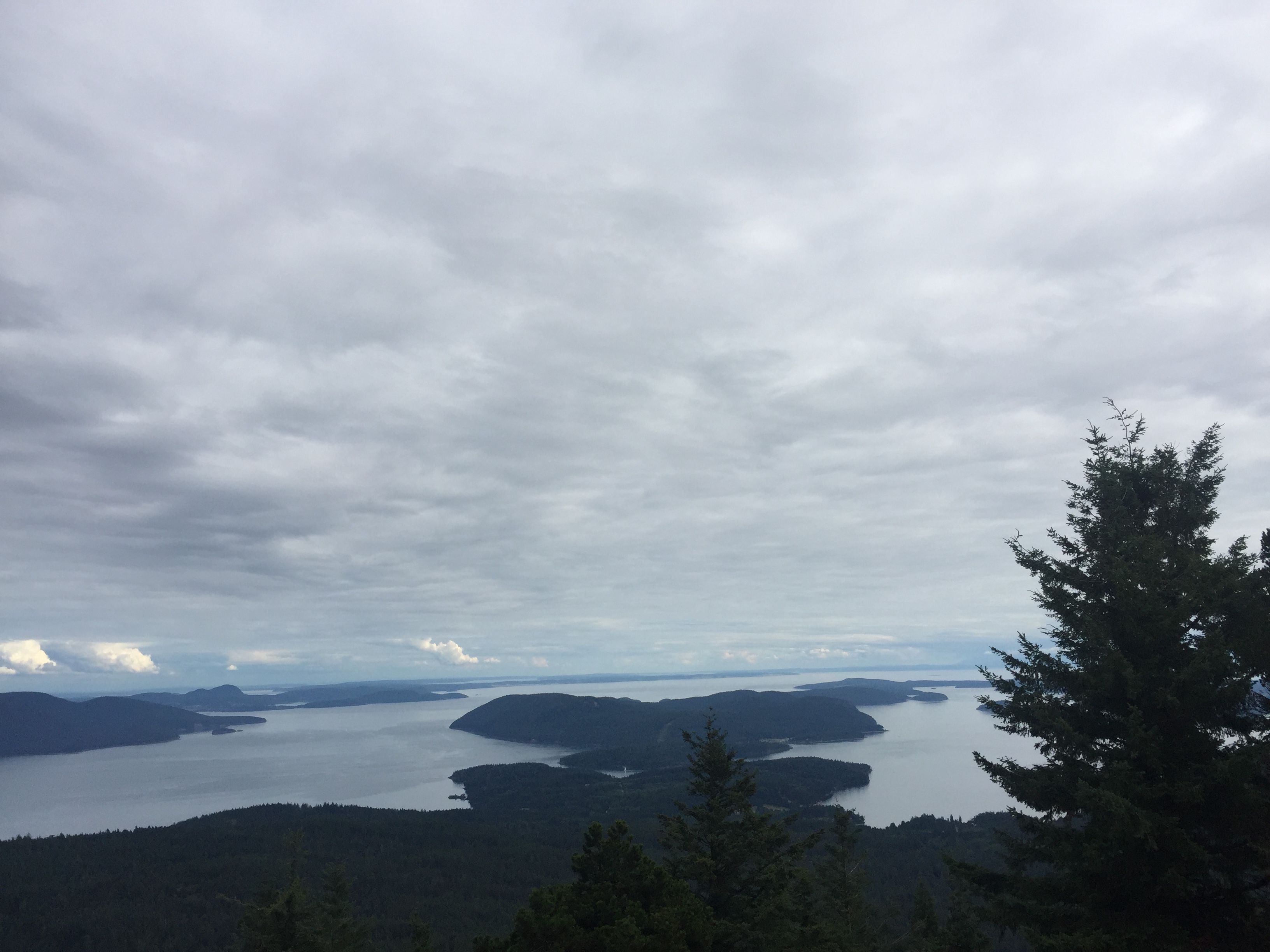
From Little Summit on Mount Constitution

Every now and then, I reflect on why I write, what I love about writing, and what is true for me now.

Here’s what I’m thinking today . . .

I crave order, and I find order by working on a project. Sometimes writing doesn’t feel like the process has any order.

My happily ever after endings are never perfect but always satisfying.

New ideas glimmer like promises on the water’s surface, but upon closer inspection, most of them lack depth.

Depth can be created.

Layers infuse while revising. I liken this experience to a complex and beautiful garden or a really great meal. All the senses work together and the journey finds a trail and satisfying destination.