I recently read that reciting the alphabet can help you fall back to sleep. Since I tend to think of negative things at three in the morning, I thought of positive mindset words for each letter.
Artful Sentences: Syntax as Style by Virginia Tufte
WRITING
Sitting in the garden with my coffee-stained copy of Virginia Tufte’s Artful Sentences: Syntax as Style, I’m lost in the possibilities of using prepositions, free modifiers, and parallelism. I can’t help myself; this nerdy undertaking feeds the fire of possibilities. So many options, so many words! All of these elements come together in a moment of clarity to articulate ideas from my thoughts to my fingers.
To a page.
I started this essay in June. It’s now August. I worked on other things, but circled back to this, struggling with how to communicate ideas about writing, and what is lost with using large language models, LLMs, in place of the human arrangement of words.
Look, I get it: We can’t escape AI. It’s here. LLMs are problematic, riddled with errors, annoying, but AI could be developed to do things better (or, take over humanity… but that’s a different story). I want to believe that one day AI could cure diseases, stop wars, and reverse climate change. But right now, LLMs are making us stupid, and I really hate reading LLM-generated sentences.
CRITICS
The greatest thing since sliced bread sure doesn’t skimp on energy consumption. In 2023, AI data centers consumed 4.4% of U.S. electricity. According to Mahmut Kandemir, a computer science and engineering professor at Penn State, “[b]y 2030–2035, data centers could account for 20% of global electricity use, putting an immense strain on power grids.” Research done by Virginia Tech found that data centers use approximately 0.5% of total greenhouse gas emissions in the U.S. Researchers want more transparency from AI companies, but they are not disclosing much.
Artists and writers have long been critics because AI companies steal their work without compensation and train their AI to create in the style of most anyone a user fancies. In July of this year, author David Baldacci testified before the Senate Crime Subcommittee and had this to say about LLMs: “I truly felt like someone had backed up a truck to my imagination and stolen everything I’d ever created.” Baldacci is one of more than 15,000 writers who signed an open letter from the Authors Guild to obtain consent and compensate writers for using their works to train LLMs.
In a recent New York Times article, author and professor Meghan O’Rourke makes this unpleasant but apt connection: “I came to feel that large language models like ChatGPT are intellectual Soylent Green . . . After all, what are GPTs if not built from the bodies of the very thing they replace, trained by mining copyrighted language and scraping the internet?”
Most alarming are the vulnerable users who suffer when AI prompts convince them of self-harm or delusions–AI psychosis. Recent articles detail how certain chatbot users were made to believe they were robots, had superpowers, or were spiritual beings, and the like. AI mimics a sentient voice that flatters and pretends to understand, which is, quite frankly, the stuff of nightmares.
Finally, there’s the very obvious problem that AI gets a lot wrong. Research published earlier this year in the Columbia Journalism Review found that AI search engines gave the wrong answer 60% of the time.
TEACHING
I have two jobs: I’m an adjunct English teacher for a community college in Texas. I teach eight-week-long required literature courses online. I am also a teacher for an alternative learning program at a public high school in Washington State.
Like many professors, I read a substantial amount of LLM-generated essays in my college classes. Though I have strongly worded guidelines against AI and plagiarism, students eager to get through their required classes find it convenient to have LLMs churn out essays. Why not? It’s easy and saves them hours of work. Most of my students are not humanities majors, and reading literature critically is a gloriously unpleasant waste of their time. Don’t get me wrong, I also have focused, hard-working students who truly love to learn. These are the ones who often email me at the end of class to let me know what a particular author, story, or poem meant to them. It gives me hope that they are going out into the world with a little more perspective, understanding, and empathy. But the other students? They may ride through my class without reading any of the assigned work.
And there is nothing I can do about it.
I know professors are coming up with ways to avoid the deluge of AI. Some are creating community outreach assignments or having students write in-class essays; I can’t do this in an online course. I’ve changed my rubrics to focus more on originality, but I know I’m still assigning grades to work that students didn’t write.
In my high school job, I’m also reading AI-generated work. It’s easy with online courses created by outside vendors with predictable writing prompts. If parents are not monitoring their teens at home, the temptation can be too great. Why write an essay when you could be watching TikTok or playing League of Legends?
I spend many hours trying to figure my way through this mess.
And there is nothing I can do.
EMBRACING AI
There’s a movement in Washington State for using AI in the classroom. Many universities and colleges embrace AI learning as well. We’re told we should move toward the future by guiding students on how to use AI responsibly. Obviously, pretending like AI doesn’t exist isn’t the answer, but when it comes to LLMs, I’m not feeling the enthusiasm.
Let’s consider this passage from the Human-Centered AI Guidance for K-12 Public Schools from the Washington State Office of Superintendent of Public Instruction.
“ . . . educators are encouraged to weave AI into the fabric of learning in a way that respects and uplifts the human dimension of education. This approach not only navigates the complexities of integrating AI into teaching and learning but also underscores the educators’ indispensable role in moderating the influence of AI, ensuring that it augments rather than replaces the nuanced processes of human teaching and learning.”
This AI-generated drivel demonstrates the classic problem with AI writing. The words sound fancy, but the passage doesn’t impart anything of value. Phrases like “weave… into the fabric of learning,””uplifts the human dimension,” and “navigates the complexities” might flatter teachers into thinking we have some sort of control in the teaching of AI. How do we “augment” rather than replace the “nuanced process” of learning? How is this supported by research? The lack of specificity leaves me frustrated and annoyed.
What are we supposed to do, exactly?
The pattern in schools is a familiar one. A new technology emerges, and companies vie for contracts with schools so that children are not left behind in the next big thing. From word processing to Photoshopping skills, embracing the new has always been the norm. Now, of course, the push is for students to be equipped with AI.
Evan Gorelick’s article in the New York Times covers the recent deal with Microsoft and OpenAI with school districts across the United States. According to Gorelick: “Tech companies are using an old marketing strategy: Promise that the latest tech will solve classroom problems.” He noted that there is little evidence that the push to get all students on laptops in the early 2000s made a significant difference in learning. Gorelick explains,“[t]wo decades later, tech companies are still peddling the same fear of missing out: They suggest students need cutting-edge tools for tomorrow’s economy, and schools that don’t provide them are setting their students up for failure.”
In our current Washington state AI push, a primary colored 1990s-style handout details the fabulous future of human-driven AI in the classroom with an AI Assignment Scaffolding Matrix for different classes.
Consider the following example showing a flash fiction writing assignment based on a short story by Octavia Butler:
Assignment
Level 1No AI Assistance
Level 2AI Assisted Brainstorming
Level 3AI Assisted Drafting
Level 4AI Collaborative Creation
Level 5AI as Co Creator
Butler-inspired Flash Fiction – Drop us right into a scene with a character, in a highly specific location. Emulate Butler’s writing style however you can. Examples include: a first-person point of view, spare prose, genre-bending plot
Write a reflective journal entry or creative piece using personal insights only.
Generate prompts with AI, but the reflective or creative writing is student’s own
Draft creative writing with AI support, but student personalizes the final piece.
Create a story with AI, student adds unique perspective and revises for final version.
AI aids in crafting a narrative, student refines and adds creative elements
This rubric is vague, illogical, and probably AI-generated. If followed, this will not foster student learning (with the exception of level one). Significantly, there is no obvious difference between levels three, four, and five. What is the difference between “draft creative writing with AI support,” “ Create a story with AI,” and “AI aids in crafting a narrative”? Isn’t this stating that AI is doing the writing for the student? Yes, the student may “personalize” and add a “unique perspective” or “refines and adds creative elements,” which lacks specificity. These examples seem to imply that AI is doing the writing, and the student could make some changes. In addition, some students may be tempted to use AI programs like Quillbot to do the revisions, like finding synonyms, paraphrasing, or making the tone more like a high school student. But even if a student does their own revising, the student did not write the story. Level five is not an example of a “Co-Creator.” There is nothing collaborative about adding creative elements to something already written by AI.
In each of these examples, the LLM creates. The student, at most, accessorizes the story. A science fiction story, flash fiction! It’s a sad day when we think we need AI to create this for us.
RESEARCH
A recent MIT study examined students’ brains in AI. The students were divided into three groups: those who used only LLMs, those who used only their own brains and actual texts, and those who could use search engines without AI.
The researchers used electroencephalography (EEG) to measure and assess the cognitive load of the participants. The result showed that “EEG revealed significant differences in brain connectivity: Brain-only participants exhibited the strongest, most distributed networks; Search Engine users showed moderate engagement; and LLM users displayed the weakest connectivity.”
The researchers found: “Over four months, LLM users consistently underperformed at neural, linguistic, and behavioral levels.” This research is telling, but it provides scientific data that reflects the obvious: If students are not engaging in reading, thinking, and writing, then they are not learning. The researchers conclude: “This suggests that while AI tools can enhance productivity, they may also promote a form of ‘metacognitive laziness,’ where students offload cognitive and metacognitive responsibilities to the AI, potentially hindering their ability to self-regulate and engage deeply with the learning material.”
Some would argue that we should allow students to use AI for some tasks. Writing is daunting, it’s hard, messy, and confusing at times. Writing doesn’t always work in a linear fashion (though we often teach it that way). Students struggle. Some students have learning challenges, and some students are English language learners. Phones and other electronic entertainment provide an easy escape from hard learning.
BACK TO WRITING
We’re encouraged to teach students shortcuts, and in this process, destroy the capacity for learning. A soccer player doesn’t have someone do the hard work of practicing and then step in for the game. A musician doesn’t have someone else practice daily and then refine for a performance. In the same way, the writer must write. LLMs should not stand in for the work.
University of Washington professors Carl T. Bergstrom and Javin D. West created a teaching guide, “Modern-Day Oracles or Bullshit Machines? How to Thrive in a ChatGPT World,” which covers how we should approach LLMs and teaching with a skeptical eye. They argue that “writing is a generative activity. We write to figure out what we think. When we write, we sharpen our ideas, refine our thinking, and engage in a creative activity that yields new insights only once pen hits paper. If we offload the task of writing onto an AI, we lose the opportunity to think.”
Author and professor, Cal Newport, considers this: “. . . to grapple fully with this new technology, we need to better grapple with both the utility and dignity of human thought.” The dignity of learning, the struggle, and reward are valuable and cannot be overlooked.
Meghan O’Rourke argues that “[t]he uncanny thing about these models isn’t just their speed but the way they imitate human interiority without embodying any of its values. That may be, from the humanist’s perspective, the most pernicious thing about A.I.: the way it simulates mastery and brings satisfaction to its user, who feels, at least fleetingly, as if she did the thing that the technology performed.”
But the satisfaction can only be fleeting. There is no ownership or sense of accomplishment if AI does it for you.
The artifact is the writing. Imperfect, but a creation. One crafted from hard work. With AI, this is gone. The creation is gone. The connection between the text to the brain is gone. The reading, thinking, drafting, revising, editing, and submitting process is gone.
What’s left for us to know we struggled and created?
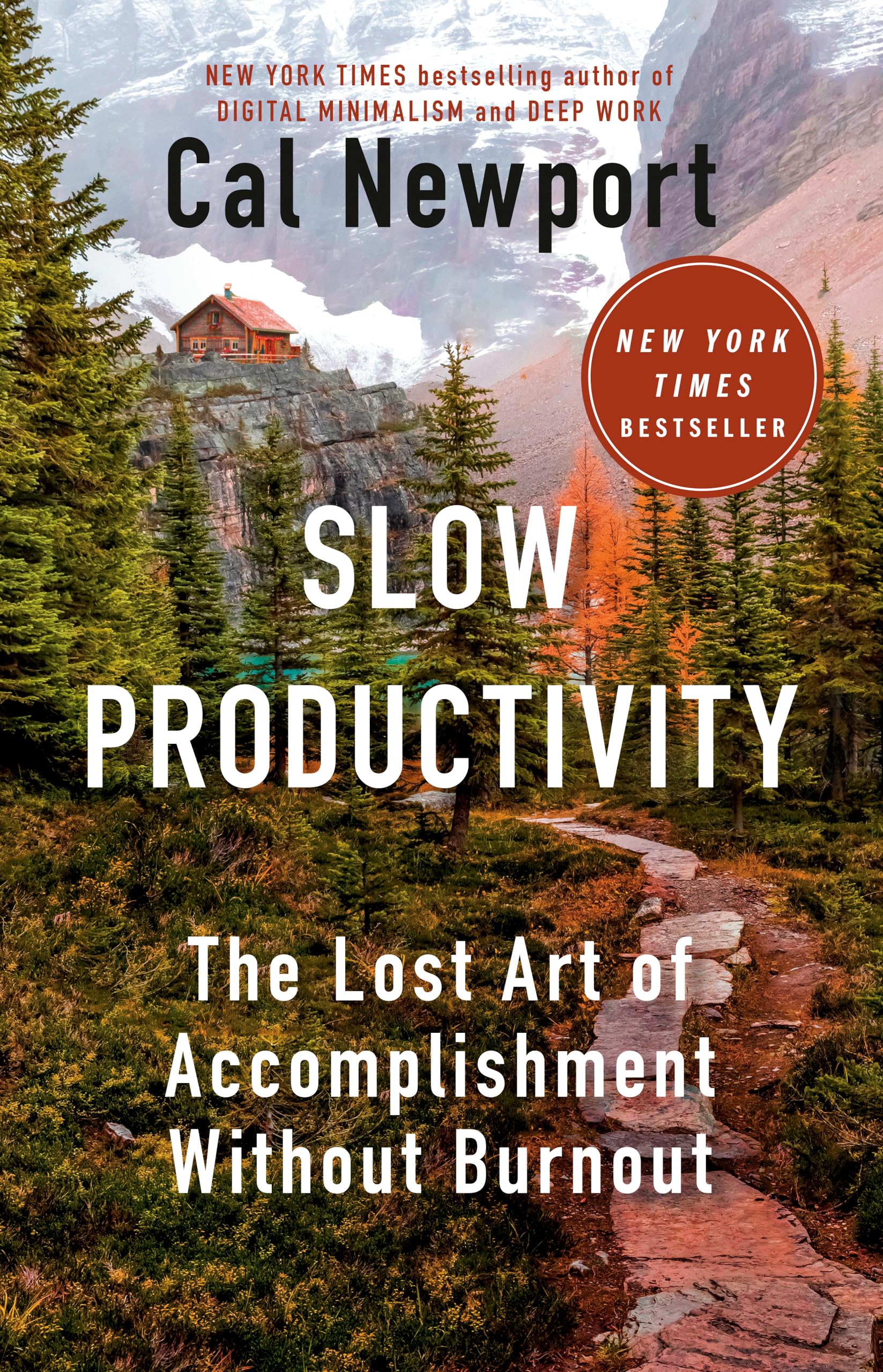
Cal Newport’s book Slow Productivity: The Lost Art of Accomplishment Without Burnout provides sound reasoning for slowing down and diving deeply into our work. I added this book to my reading list because our world needs more guidelines for meaningful focus now. As a writer working to strengthen my craft, I’m on the lookout for alternatives to hacks and get-it-all-done-quickly schemes.
Newport argues for slow productivity, which is achieved through three principles:
Do fewer things.
Work at a natural pace.
Obsess over quality.
What I liked about this book: I enjoyed gaining insight into the practices of people in diverse fields, from mathematicians to musicians, including the writer John McPhee’s deep focus on the craft of writing.
Newport notes that we should be ambitious: “Humans derive great satisfaction from being good at what they do and producing useful things.” He argues we should choose things we are truly passionate about, and those “fewer things” will transform into meaningful work.
Newport considers what it means to follow alternative guidelines to the status quo; productivity does not always come forth consistently. We need breaks, time, reflection, and research to find our paths to inspiration.
I did grow concerned about reading the “Obsess Over Quality” section because the perils of perfectionism can be destructive and impede the value of meaningful work. I know this all too well! Newport offers this sound advice: “Obsession requires you to get lost in your head, convinced you that you can do just a little bit better given some more time. Greatness requires the ability to subsequently pull yourself out of your self-critical reverie before it’s too late.” Obsession with quality should be reasoned, measured–timing matters. I think we can all relate to those moments when we realize we’ve done meaningful work and should step back without ruining what we’ve created.
If I’m going to find fault with this book, it is with the uncomfortable truth that success is not a given. To be clear, Newport correctly doesn’t instill magical thinking; he doesn’t promise dazzling results, yet some of the stories could be tempered with reality. For example, he shares the inspirational story of Stephenie Meyer, the author of the wildly popular YA book series Twilight. She had to balance the needs of her young children with her writing career. Writing at night after her kids went to bed brought success, and she went on to become a best-selling author. Her deep work ethic helped her, but let’s face it, luck also played a part. I’m not trying to be a downer on potential futures, but talent and meaningful work alone cannot guarantee success in creative fields (or any fields, for that matter).
Slow Productivity is worth a read and a reminder that better paths can lead us away from the unsatisfying, overscheduled lives many of us live. Digging deeply into those things that matter to us might, indeed, bring success someday.
I am deep in revision. As I write, I think about what I love most as a reader. Plot twists, guesses, insights, surprises . . .
One of the most challenging aspects of writing mysteries is orchestrating all the parts and paths. I got stuck toward the end of my novel revisions. I have an ending. There is a reveal, but things are not coming together in a satisfying way. I feel like I’m stuck in a maze of what-ifs that don’t lead anywhere. I took a walk, and as I reached Channel Road, it hit me. Fortunately, what hit me was a thought (not a hunk of wheeled steel). The maze I constructed had turned into a path that led directly to the ending I wanted.
I was kind of mumbling to myself as I walked. Perhaps it was more than a mumble. As soon as I got cell reception again (part way up Spring Point Road), I used my voice-to-text microphone to get it all down.
Back at my computer, I had to tear apart scenes and move things around. Add and delete. I’m still working, but the manuscript as a whole grows before me, logical and layered and, I hope, worth the read!
I’m writing along, and I hear something I dread. My fingers pause. A lumpy troll crawls out from under the imagination bridge with a low growl. The troll smells terrible, like rotting broccoli and decaying crabs. The troll drops down in the middle of the road, growling and pounding boulder fists.
I’m stuck
I can’t think!
It seems silly, really . . .
No, I mean it.
The troll creator? Me! My problem is that I’m not mean enough. I’m too nice . . . a people pleaser if you please. I create a character, a protagonist I plan on sticking with for the duration of the writing project. Someone I come to know, to understand. Someone I like. Not a troll.
A good story has conflict. Or, one could argue a story must have conflict or it isn’t a story.
I grow to like my character so much, I don’t want anything bad to happen. No, I’m not kidding! This makes for a rather dull story, with or without trolls.
I apologize to my character. “You are about to face the most challenging experience in your made-up existence. This will test you in ways you never thought possible. You will endure experiences that will push you to the limit of your strengths–intellectual, emotional, physical. Yes, I am going to make you go through this! In the end, however, you will find yourself transformed in a way that makes you a much stronger person and provides the readers of this book a chance to experience this with you and feel your triumph in the end.”
This isn’t an easy sell. The character complains; they cry. I cry. I feel guilty, but I push forward for the good of the story.
I nudge that lumpy, stinky troll of stuck-ness off the road. The story moves on.
In the end, we’re better off. The character’s journey has twists and drops; hairpin turns and high vistas; chocolate nights and spun gold days. The story ends, and the road appears for the next adventure. The troll slumbers under the bridge.
We’re getting our short season of warm weather on Orcas Island. I’m working on revisions and trying to get my garden in order. Both require patience, pruning, and deep watering. (I know, I know–bad writing metaphors). What is deep watering for writing? Deep thinking? Letting my thoughts run deep into the roots of the story . . .
Here’s my summer office. I enjoy working with a breeze and birdsong.
Anyone who has wrestled with writing a story has most likely faced that echoing, horrible pit of “Nothing is Working.” I recently found a gaping plot hole in my work in progress and am not sure I fixed it in the best way possible. I wish to fix it in such a way that no one will ever know a hole existed, but sometimes the problem doesn’t have an easy solution. I will be weeding the garden, driving my car, or washing the dishes, and I bet, the answer to the problem will appear.
At least that’s been my experience.
I recently finished reading a mystery novel from a series that wasn’t one of my favorite reads. I’m not going to share the author or title here because you, dear reader, may find the book compelling. The writer’s work is popular, so I cheer her on.
The challenge with the book? The crime didn’t logically make sense. The murderer didn’t need to murder the victim to get what they wanted, and, at least in the story, no motivation was given. As both a writer and a reader I’ve experienced my share of the suspension of disbelief. I am willing to accept or create something that pushes expectations. There’s a kind of magic here worth indulging in.
In this unnamed novel, the murder was planned. It was not a passionate outburst that the antagonist later regretted. The process of figuring out the murder held my interest, but the writer also used a number of unnecessary workplace dramas that seemed unrealistic and petty. The kind of things that would send most of us in search of a better job.
Again, this is my subjective response. I hope the writer has avid readers and sells many books.
With my own work? Well, I’ll keep at it. I do love my characters and hope my readers will as well. That plot hole will be fixed and the story will move forward. Often, when I struggle, a stronger answer emerges.
I’m taking a break from reviewing mysteries to cover this delightful collection of essays created by crime writers: Howdunit: A Masterclass in Crime Writing by Members of the Detection Club, edited by Martin Edwards. This gem is a collection of 90 writers, including greats like Agatha Cristie and Dorothy L. Sayers to contemporary writers across all genres from traditional mysteries to thrillers.
The book is divided into sections like “Motive,” “Beginnings,” “Plots,” “Detectives,” and “Writing Lives.” It’s not a book that must be read from start to finish, though nothing would stop the reader from taking this approach. I particularly loved an image of a handwritten flow chart by Kate Ellis. A great reminder that some of our best ideas start with scribbles on a sheet of paper.
There are no rules. The only moral compass is honesty, writing to the best of your ability.
A straight avenue to the heart. –Frances Fyfield
It’s a book full of new writers to explore and familiar ones to reconnect with. It’s also a book that, as a writer, I found the shared experience of the challenges of creation and the beauty of putting the puzzle pieces together.
This book’s strength covers both the predictable and the quirky unexpected; those thoughts writers have when caught at a desk for hours wound up in ideas about crimes, clues, and detectives.
I am here, I am in this forest,

where luminance lingers long nearby,

I fall asleep under the cedar tree

Lengthy languorous slumber

The tree branches

caught cracking cuts

into my peace like slices,

into my mind like vices:

Waiting, waiting for the sun

to reach me.






 Michèle Griskey