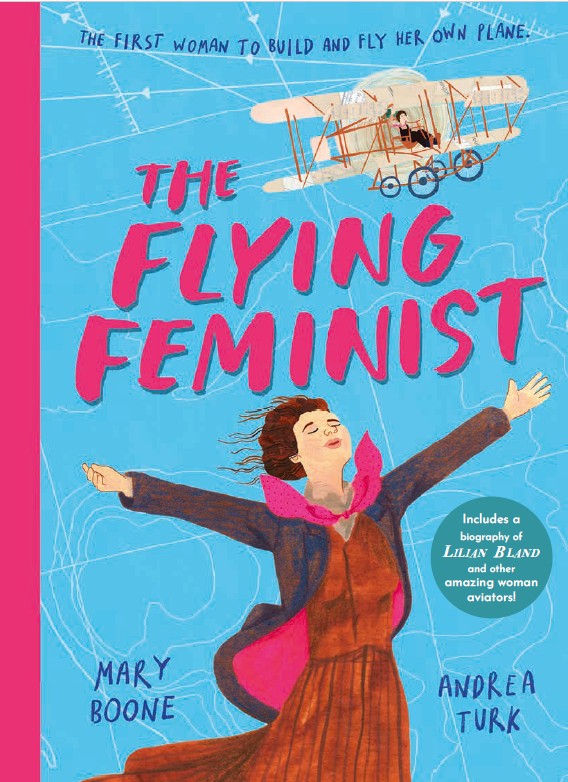
The Flying Feminist, a Review

The Flying Feminist 

Written by Mary Boone

Illustrated by Andrea Turk

When I was in the 6th grade, our teacher assigned us a research project on a scientist or inventor of our choice. I decided I wanted to write about a female scientist, so I went to the library to look for books about women in science. Since this was back in the Cretaceous Period, the only book I found was on Marie Curie, a worthy scientist, but where were all the other innovative women?

As an adult, I’ve had the opportunity to research previously overlooked women, and it’s wonderful to see, finally, picture books on scientists and inventors such as Ynes Mexia, Mae Jemison, Roselind Franklin, and many more.

I recently had the opportunity to read Mary Boone’s latest book, The Flying Feminist, illustrated by Andrea Turk, and I marveled learning about an inventor I hadn’t known about before.

The Flying Feminist is the story of the innovative, Lilian Bland. During the time of aviation’s infancy, Lilian designed, built, and flew her own airplane. The story introduces us to Lilian who challenged society’s expectations for women in many ways; from wearing trousers to covering sports as a journalist, Lilian wasn’t afraid to do what she wished. When she learned about aviation and airplanes, she decided she wanted to fly.

Lilian faced many obstacles, and she overcame them with clever solutions. Readers find out if the airplane she designed and built herself will actually fly.

The story is told with beautiful, bright illustrations showcasing Lilian’s inspiration and perspiration to achieve her goals. Mary Boone’s clear and lyrical writing brings excitement to every page.

This would be a wonderful book for any reader curious about a woman who turned her dreams into real adventure. If I were back in the 6th grade, I know I would have wanted to learn about The Flying Feminist (no offense to Marie Curie, of course).

2026

More

Projects I’m passionate about

Research that interests me

Humor, always

Family, always

Time outside with hikes and garden work

Time inside with a snuggly kitty

Lifting heavy weights the right way (both in the gym and those metaphorical weights that seem to get in the way).

Fresh starts and finishing strong

Leo Carrillo Beach, January 1, 2026

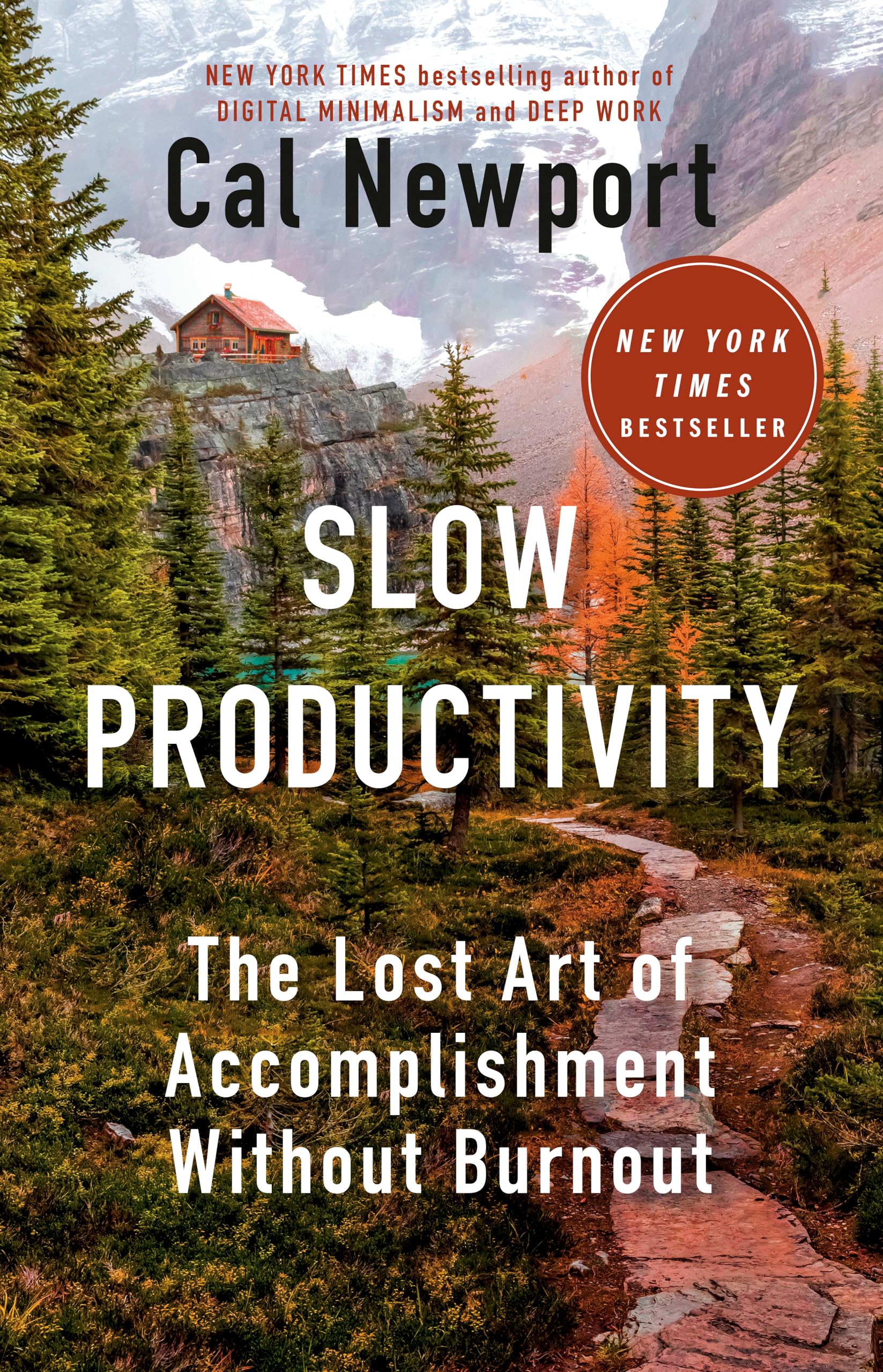
Slow Productivity–A Review

Image of the book cover

Cal Newport’s book Slow Productivity: The Lost Art of Accomplishment Without Burnout provides sound reasoning for slowing down and diving deeply into our work. I added this book to my reading list because our world needs more guidelines for meaningful focus now. As a writer working to strengthen my craft, I’m on the lookout for alternatives to hacks and get-it-all-done-quickly schemes.

Newport argues for slow productivity, which is achieved through three principles:

Do fewer things.

Work at a natural pace.

Obsess over quality.

What I liked about this book: I enjoyed gaining insight into the practices of people in diverse fields, from mathematicians to musicians, including the writer John McPhee’s deep focus on the craft of writing.

Newport notes that we should be ambitious: “Humans derive great satisfaction from being good at what they do and producing useful things.” He argues we should choose things we are truly passionate about, and those “fewer things” will transform into meaningful work.

Newport considers what it means to follow alternative guidelines to the status quo; productivity does not always come forth consistently. We need breaks, time, reflection, and research to find our paths to inspiration.

I did grow concerned about reading the “Obsess Over Quality” section because the perils of perfectionism can be destructive and impede the value of meaningful work. I know this all too well! Newport offers this sound advice: “Obsession requires you to get lost in your head, convinced you that you can do just a little bit better given some more time. Greatness requires the ability to subsequently pull yourself out of your self-critical reverie before it’s too late.” Obsession with quality should be reasoned, measured–timing matters. I think we can all relate to those moments when we realize we’ve done meaningful work and should step back without ruining what we’ve created.

If I’m going to find fault with this book, it is with the uncomfortable truth that success is not a given. To be clear, Newport correctly doesn’t instill magical thinking; he doesn’t promise dazzling results, yet some of the stories could be tempered with reality. For example, he shares the inspirational story of Stephenie Meyer, the author of the wildly popular YA book series Twilight. She had to balance the needs of her young children with her writing career. Writing at night after her kids went to bed brought success, and she went on to become a best-selling author. Her deep work ethic helped her, but let’s face it, luck also played a part. I’m not trying to be a downer on potential futures, but talent and meaningful work alone cannot guarantee success in creative fields (or any fields, for that matter).

Slow Productivity is worth a read and a reminder that better paths can lead us away from the unsatisfying, overscheduled lives many of us live. Digging deeply into those things that matter to us might, indeed, bring success someday.

Finding

Beware of digging into things you should not. It never turns out well; the revelation will be painful, though predictable, and scar the guts deeply.

Answer: find the path forward—boldly, with full feathers and song.

August Sunrise