About brush fires and California

One: Drought
Over 250 days without rain. Somewhere after the 200th day, we walk. Breathe the citrus and jasmine blossoms, fog and sea brine. As we walk along Harvester Avenue and up Busch Drive, the morning cloud cover dissolves, leaving abundant sunshine bouncing off the surface of the sea, shimmering where squid boats gather and cast the night in blotches of bright green lights: Sea stars.
The ocean cools the offshore breeze, the shouts of kids playing, dogs barking, and the scent of horses wafting from the fields. Malibu Park; these are the days I like best–
Winter in Southern California.
Until there’s a shift, a page turn of landscape, a contrast, seemingly of countries, of planets even. We wonder if we stumbled into a portal to Mars.
It’s the water.
We left the lawns and xeriscapes, the palm trees, the roses, and the century plants with pointy hat plumes. The neighborhood of intentional water and the Zuma Ridge trailhead, where the real drought lives, no irrigation, sprinklers, drip hoses–instead, a place of life and death, of movement and quiet. The divide where the umber dusty trail heads into the dark mountains. Where someone could disappear.
And fires could start.
Something here is off.
In late December, the mountains are usually cast in the green fuzz of new growth. Instead, we are surrounded by dead things. A landscape more like September than two days before the new year. Chaparral, dry and crisp. The breeze rattles the plants like snakes lifting their tails to threaten.
We are unsettled here.
Two: Wind
Raymond Chandler wrote:
“There was a desert wind blowing that night. It was one of those hot dry Santa Anas that come down through the mountain passes and curl your hair and make your nerves jump and your skin itch. On nights like that every booze party ends in a fight. Meek little wives feel the edge of the carving knife and study their husbands’ necks. Anything can happen.”
Joan Didion wrote:
“Los Angeles weather is the weather of catastrophe, of apocalypse, and, just as the reliably long and bitter winters of New England determine the way life is lived there, so the violence and the unpredictability of the Santa Ana affect the entire quality of life in Los Angeles, accentuate its impermanence, its unreliability. The winds shows us how close to the edge we are.”
Anything can happen,
Close to the edge.
Santa Anas, a sense of anticipation, change, a departure from the norm: Tumbleweeds rolling. The stars, always brighter. The spray from the waves along the beach goes the opposite way. The normally smog-free coast casts a bathtub ring on the horizon, reminding us of the ick in the air we breathe.
There were good Santa Ana days:
The time the Goodyear Blimp, like a bouncy, loyal pet, followed me on my walk to school
We’d run around during recess holding our jackets open over our heads as sails.
Electric and alive–
Anything can happen. And we were on the edge.
Santa Anas stirred disasters: howled down our chimney, knocked lawn furniture around. Fueled brush fires from the valley to the coast in a matter of hours.
The winds have power.
Three: Fire
Smoke mass: Brown pillowing, gray ash, and a mean red center, raw wound, hell escape eating the chaparral in gulps.
The mountains are fire.
The flames eat a wide horizontal path down with a roar and whoosh of twirling heat and wind. Crackle and booms, of prayers and sirens–Smoke choked oxygen and red ember scattering and swirling over to the next house and the next. Eucalyptus trees explode, torch as roofs collapse, walls fall in, the metal edges of windows melt and twist into macabre bones: only the chimneys remain. Sentinels above the ruin.
After the Woolsey Fire, returning to my childhood neighborhood is like Dorothy sidestepping Oz and arriving in the land of Borg Cubes from Star Trek. Vast, austere steel and concrete boxes, the post-fire architecture of Malibu Park, the phoenix houses from the ashes.
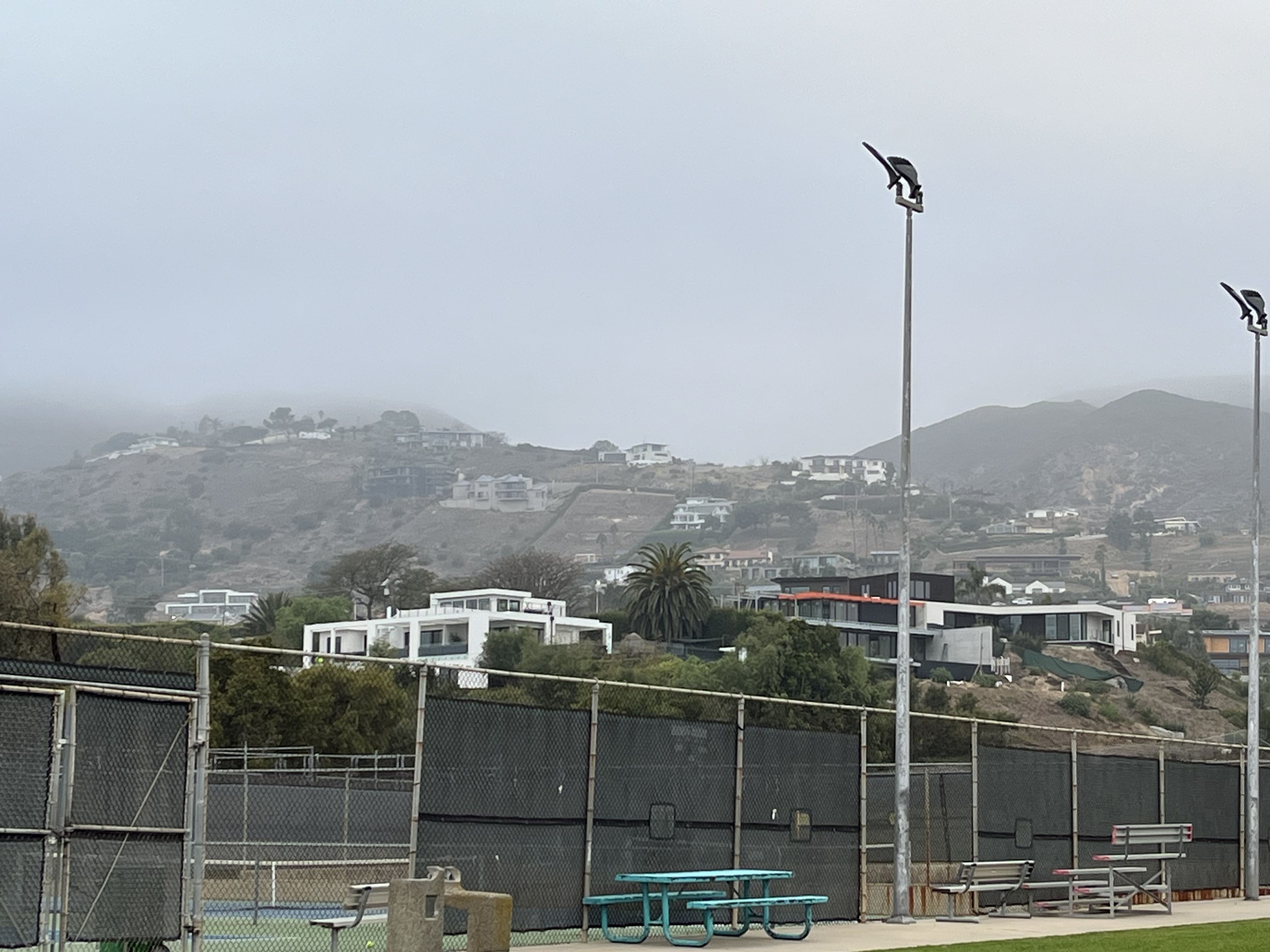
These are what people build now to stay safe.
Or so they hope.
Driving toward LA, the charcoal black laces the center of Malibu from the Franklin Fire, but as we travel south on PCH, I see all the familiarity of the other end of Malibu. The places that have been there always, the quintessential, the steady, the sure: Malibu Feed Bin, where we got our Christmas trees, the little shack restaurant, Reel Inn with the neon sign of a leaping fish. So many places huddled up along the coast, houses on the hills, in the canyons, the beach, Topanga, the Palisades . . .
Those are all gone now.
Our bodies are resilient to a point; our mental health can only take so much. The Earth has endured, but what are we doing now to hasten the heat? The previous year was the hottest on record. This past January was the hottest January on record.
People look for easy fixes. Despite what’s been said, it’s not about raking the forest or controlled burns or logging or whatever.
It’s certainly not about turning on the water and flooding the Central Valley!
Chaparral doesn’t work that way.
But we keep coming back to this Paradise Hellscape, because when life’s good, it’s so good. The Mediterranean climate is a craving. Morning coffee bathed in sunlight, hummingbirds and sparrows, magenta geraniums and bougainvillea, the rhythmic curl of the waves reaching up the beach.
The sunset’s glow–sky fire turning to night.
Until it isn’t anymore.
This is about drought and winds and the stuff that gets in the way . . .

 Michèle Griskey