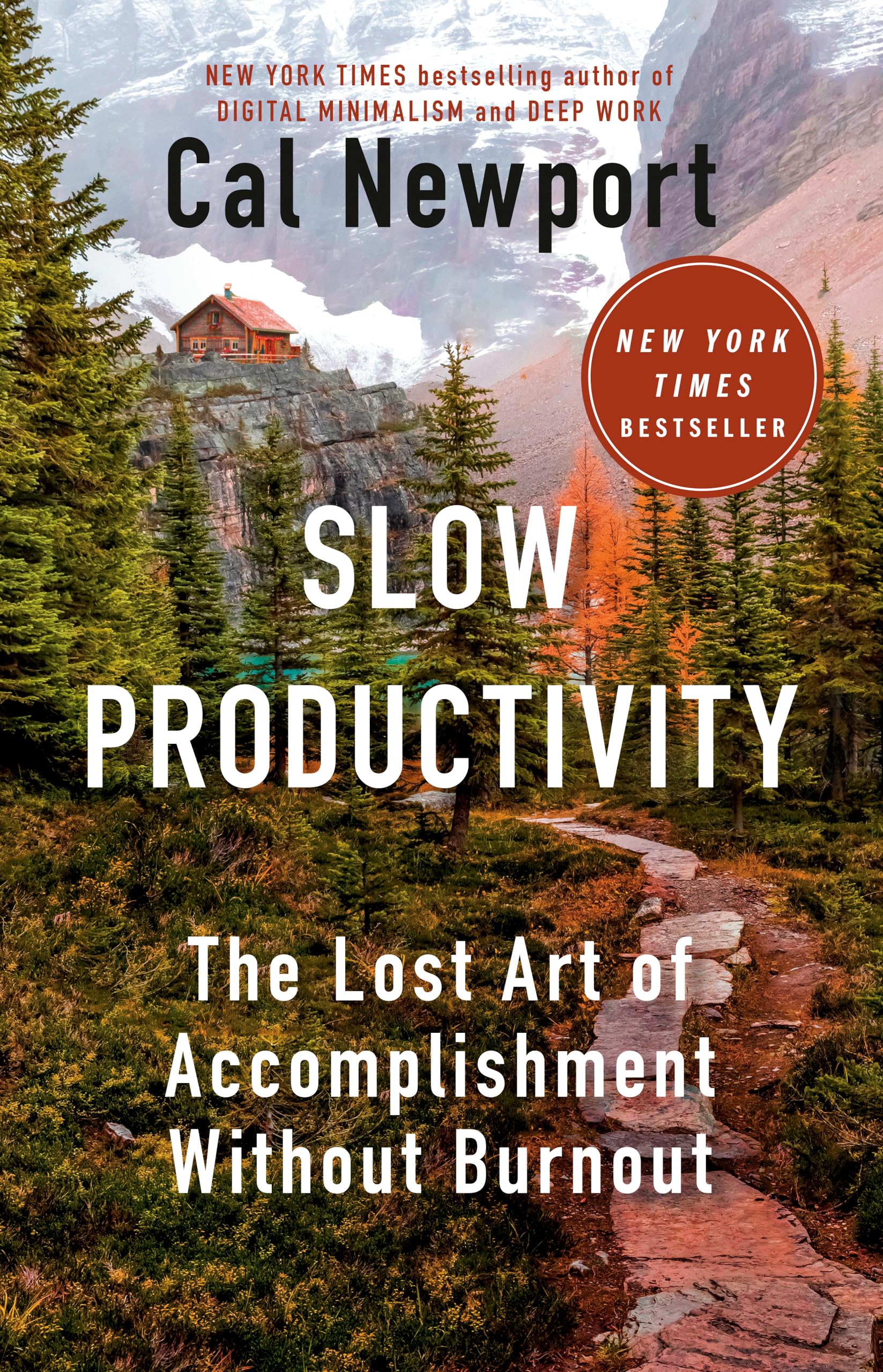
Cal Newport’s book Slow Productivity: The Lost Art of Accomplishment Without Burnout provides sound reasoning for slowing down and diving deeply into our work. I added this book to my reading list because our world needs more guidelines for meaningful focus now. As a writer working to strengthen my craft, I’m on the lookout for alternatives to hacks and get-it-all-done-quickly schemes.
Newport argues for slow productivity, which is achieved through three principles:
Do fewer things.
Work at a natural pace.
Obsess over quality.
What I liked about this book: I enjoyed gaining insight into the practices of people in diverse fields, from mathematicians to musicians, including the writer John McPhee’s deep focus on the craft of writing.
Newport notes that we should be ambitious: “Humans derive great satisfaction from being good at what they do and producing useful things.” He argues we should choose things we are truly passionate about, and those “fewer things” will transform into meaningful work.
Newport considers what it means to follow alternative guidelines to the status quo; productivity does not always come forth consistently. We need breaks, time, reflection, and research to find our paths to inspiration.
I did grow concerned about reading the “Obsess Over Quality” section because the perils of perfectionism can be destructive and impede the value of meaningful work. I know this all too well! Newport offers this sound advice: “Obsession requires you to get lost in your head, convinced you that you can do just a little bit better given some more time. Greatness requires the ability to subsequently pull yourself out of your self-critical reverie before it’s too late.” Obsession with quality should be reasoned, measured–timing matters. I think we can all relate to those moments when we realize we’ve done meaningful work and should step back without ruining what we’ve created.
If I’m going to find fault with this book, it is with the uncomfortable truth that success is not a given. To be clear, Newport correctly doesn’t instill magical thinking; he doesn’t promise dazzling results, yet some of the stories could be tempered with reality. For example, he shares the inspirational story of Stephenie Meyer, the author of the wildly popular YA book series Twilight. She had to balance the needs of her young children with her writing career. Writing at night after her kids went to bed brought success, and she went on to become a best-selling author. Her deep work ethic helped her, but let’s face it, luck also played a part. I’m not trying to be a downer on potential futures, but talent and meaningful work alone cannot guarantee success in creative fields (or any fields, for that matter).
Slow Productivity is worth a read and a reminder that better paths can lead us away from the unsatisfying, overscheduled lives many of us live. Digging deeply into those things that matter to us might, indeed, bring success someday.
I’m writing along, and I hear something I dread. My fingers pause. A lumpy troll crawls out from under the imagination bridge with a low growl. The troll smells terrible, like rotting broccoli and decaying crabs. The troll drops down in the middle of the road, growling and pounding boulder fists.
I’m stuck
I can’t think!
It seems silly, really . . .
No, I mean it.
The troll creator? Me! My problem is that I’m not mean enough. I’m too nice . . . a people pleaser if you please. I create a character, a protagonist I plan on sticking with for the duration of the writing project. Someone I come to know, to understand. Someone I like. Not a troll.
A good story has conflict. Or, one could argue a story must have conflict or it isn’t a story.
I grow to like my character so much, I don’t want anything bad to happen. No, I’m not kidding! This makes for a rather dull story, with or without trolls.
I apologize to my character. “You are about to face the most challenging experience in your made-up existence. This will test you in ways you never thought possible. You will endure experiences that will push you to the limit of your strengths–intellectual, emotional, physical. Yes, I am going to make you go through this! In the end, however, you will find yourself transformed in a way that makes you a much stronger person and provides the readers of this book a chance to experience this with you and feel your triumph in the end.”
This isn’t an easy sell. The character complains; they cry. I cry. I feel guilty, but I push forward for the good of the story.
I nudge that lumpy, stinky troll of stuck-ness off the road. The story moves on.
In the end, we’re better off. The character’s journey has twists and drops; hairpin turns and high vistas; chocolate nights and spun gold days. The story ends, and the road appears for the next adventure. The troll slumbers under the bridge.
This is the time of year I love most (even if my allergies disagree).
A bald eagle in a tree near the North Valley Overlook on Turtleback Mountain
The birdsong and frog song, the succession of blooming plants, the longer days, and the shifts between sunshine and rain.
I’m finishing up a project that I’ll be sad to leave. I love the characters, the setting, the story. I’m sure I’ll be doing future revisions and edits, shifting and changing, but for now, I’m going to move onto the next big thing.
These moments of shifting can feel good. “Hey, I finished a book!”
Yet, I can also feel unsure.
The possibility awaits: wonderful and scary; exciting and daunting; a dash forward and a long pause. All those contrasts hit me, freeze me.
I’m back to the act of creating again. The pen to the notebook–



 Michèle Griskey